Synastry vs. Composite Chart: What’s the Difference?
Galaxia describes what a chart shows, not what will happen. How we write about astrology →

If you have looked into relationship astrology, you have run into two terms that sound similar and are used differently: synastry and composite. Many guides treat them as interchangeable or say “get both” without explaining why. Here is a plain explanation.
Next step
Add two birth dates and see where your charts flow and where they catch.
Compare two charts freeThe one-sentence difference
Synastry compares your two charts as they are. A composite chart blends them into a third chart that represents the relationship itself.
That distinction changes what each one can tell you.
Synastry: two people, side by side
In synastry, you keep both charts intact and look at how the planets in one relate to the planets in the other. Where does your Moon sit in relation to their Venus? Does their Saturn press on your Sun? Those relationships are called aspects.
Because each person’s chart stays whole, synastry answers questions about the two of you as individuals:
- How does each of us tend to affect the other?
- Where do we understand each other easily, and where do we misread each other?
- Who is more likely to feel a given dynamic more strongly?
The last one matters. Synastry contacts are often lopsided. One person’s Mars may press on the other’s Moon without the reverse being true. That asymmetry is often the most useful thing a comparison shows.
Composite: the relationship as its own entity
A composite chart takes the midpoint between each pair of planets, yours and theirs, and builds a new chart from those midpoints. Your Sun and their Sun produce a composite Sun. Your Moon and their Moon produce a composite Moon.
The result is a single chart that describes the relationship as if it were a third party. It answers different questions:
- What is the purpose or theme of this relationship?
- What does it feel like to be in it, rather than to be either one of us?
- What does the partnership do as a unit?
Composite charts are good at describing the character of the pairing. They are not good at telling you who is doing what.
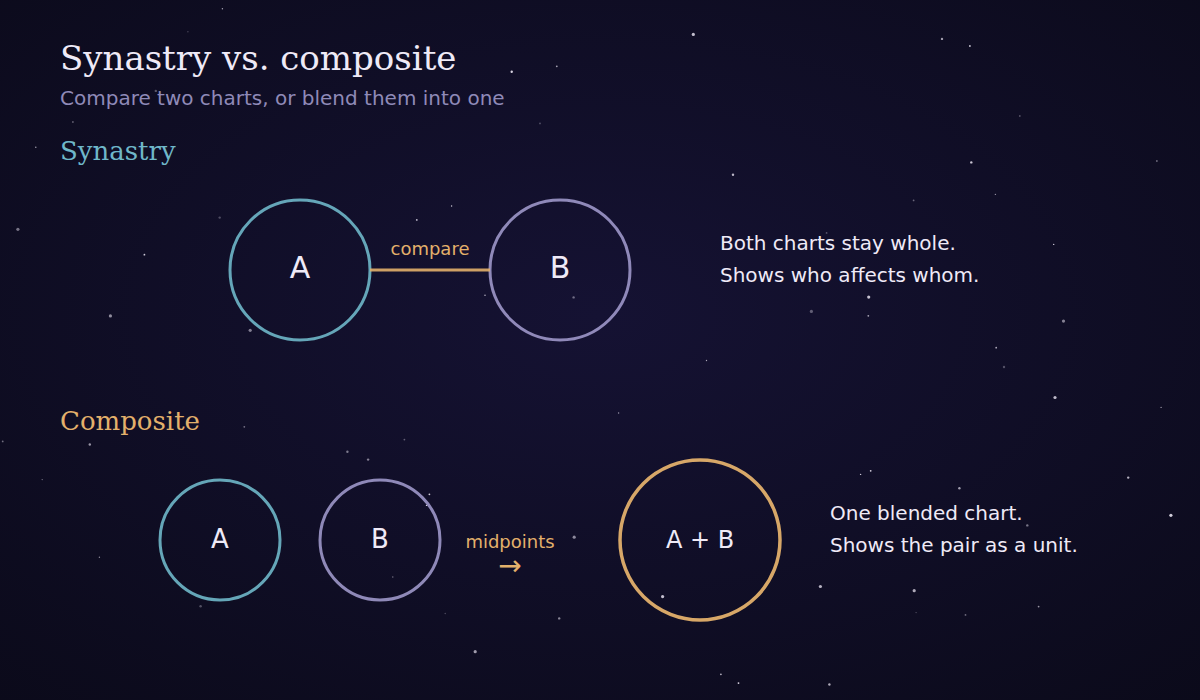
Text description of this diagram
Title: ‘Synastry vs. composite.’ Synastry: circles A and B joined by a line labeled compare; both charts stay whole and it shows who affects whom. Composite: circles A and B feed through midpoints into one circle labeled A + B; it is one blended chart that shows the pair as a unit.
Where each falls short
Synastry can produce an overwhelming list of aspects. Every pair of charts has dozens of contacts, and without a sense of proportion it is easy to fixate on a difficult one and ignore everything else.
Composite flattens the two people into one. It can describe a relationship as “intense” without telling you whether one person is driving that intensity. It also depends on a calculation choice (midpoints), and there is more than one way to do it, which means composite charts from different tools may not match.
Which one should you use?
It depends on what you are asking.
| If your question is... | Start with |
|---|---|
| “Why do we react to each other this way?” | Synastry |
| “Who tends to feel this more?” | Synastry |
| “What is this relationship about?” | Composite |
| “What is the overall tone of us as a pair?” | Composite |
| “How do I handle a specific recurring conflict?” | Synastry |
For most people in an ongoing relationship, synastry is the more practical starting point, because it lets you see how each person contributes. Composite is a good second layer once you have that.
How we approach it at Galaxia
Galaxia focuses on comparing charts side by side, because the people in your life are individuals, not one merged entity. We show where the two charts flow (where things come easily) and where they catch (where friction is likely), and we leave it at description rather than prediction. If you want to understand what a comparison actually tells you, start with what a synastry chart tells you about a relationship you’re already in, or add someone to your galaxy and try it.
A comparison is a way to ask better questions of each other. It is not a verdict.
A birth chart describes how someone is built. It does not predict what they will do. How Galaxia handles astrology.
See it in your own charts
Add two people’s birth details and Galaxia calculates where their charts connect and where they catch, using astronomical positions. The comparison is free.
Compare two charts freeRead next
What Neptune in Synastry Actually Means in a Relationship
Neptune aspects in synastry are often read as “soulmate” or “illusion.” Here is the mechanism behind both, and a simple test for telling them apart.
Moon Sign in Relationships: Why You Need Different Things
Your Moon sign describes how you process feelings and what helps you feel secure. Here is how to read it next to a partner’s Moon in a birth chart.