What Neptune in Synastry Actually Means in a Relationship
Galaxia describes what a chart shows, not what will happen. How we write about astrology →
Search “Neptune in synastry” and nearly every result does the same thing: it defines the aspect and stops. Conjunction: deep spiritual connection. Square: illusion and deception. Trine: dreamy harmony. That is a dictionary, not an explanation, and it leaves you no better equipped to understand your actual relationship.
The recent Full Moon at Neptune (September 26) put the planet in a lot of conversations, but this post is not tied to a single week. The pattern it describes is worth understanding whenever it shows up.
Next step
Add two birth dates and see where your charts flow and where they catch.
Compare two charts freeThe short version
Neptune in synastry means one person’s planet touches the other’s in a way that blurs the boundary between them. Neptune is the planet of dissolving edges: imagination, idealization, compassion, longing, and, when it is not working well, confusion.
When your Neptune contacts someone’s Sun, Moon, Venus, or Mars, you tend to experience them through a soft-focus lens. You may see who they could be rather than who they are. That can feel like love at its most tender, and it can feel like being unable to see them clearly. Often it is both.
The mechanism: projection, not magic
Here is the useful reframe. Neptune synastry is less a statement about the relationship and more a description of what one person tends to project onto the other.
Whoever has Neptune making the contact is the one more likely to idealize. Whoever’s planet is being touched is the one who may feel seen in a way that is flattering, or feel pressure to live up to an image that is not quite theirs.
Neither is wrong. Idealization is how a lot of relationships begin. The issue is what happens when the picture and the person diverge.
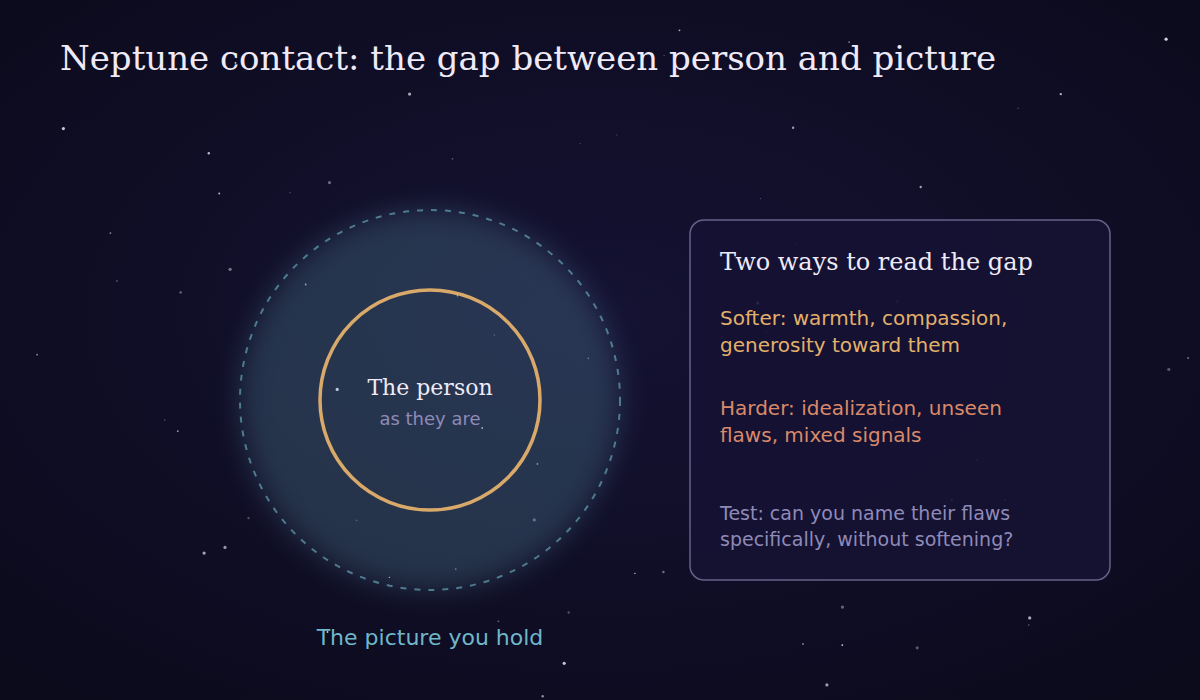
Text description of this diagram
Title: ‘Neptune contact: the gap between person and picture.’ A solid gold circle labeled ‘The person as they are’ sits inside a larger, softer dashed teal circle labeled ‘The picture you hold.’ A box titled ‘Two ways to read the gap’ says: Softer: warmth, compassion, generosity toward them. Harder: idealization, unseen flaws, mixed signals. A final line gives a test: can you name their flaws specifically, without softening?
What it looks like by planet
Neptune and Venus: Romance, aesthetic attraction, an ideal of love. Strong pull, and a tendency to overlook faults.
Neptune and the Sun: One person may feel they have found the “real” version of the other, or may feel unusually inspired by them. It can also mean the Sun person feels slightly unseen.
Neptune and the Moon: Emotional attunement, sometimes to the point of absorbing each other’s moods. Beautiful, and easy to lose your own footing in.
Neptune and Mars: Attraction that is hard to pin down. Action and desire feel less direct, sometimes to the point of mixed signals.
Neptune and Mercury: Conversations that feel intuitive, and misunderstandings that feel like they should not be happening. You may hear what you hoped they meant.
Conjunction, square, trine, opposition
The type of aspect changes how the blur behaves.
- Conjunction: The strongest and most immediate. Hard to separate the person from the feeling.
- Trine and sextile: Easier. The idealization is gentler and often shows up as generosity and shared imagination.
- Square and opposition: More friction. The gap between the picture and the person becomes visible sooner, and that can feel like disappointment.
A test you can actually use
Astrology can describe a tendency. It cannot tell you whether your relationship is healthy. How Galaxia handles astrology. Here is a way to check for yourself:
Can you describe this person’s flaws specifically, without softening them?
If you can name three ways they are hard to live with, and you still choose them, the Neptune contact is probably adding warmth rather than fog. If you notice you cannot, or that every flaw arrives with an excuse already attached, that is worth paying attention to.
Then reverse it: could they describe yours? Neptune runs both ways. Sometimes the person being idealized is the one who feels least known.
What to do with it
- Name it. Simply knowing the contact exists makes idealization easier to catch.
- Ask instead of assuming. Where you are filling in gaps about what they think or feel, ask them.
- Check it against evidence. What have they actually done over months, not what you sense they meant?
- Keep what is good. Neptune contacts are also where compassion, creativity, and forgiveness live. The goal is clear sight, not less love.
Where to go from here
Neptune is one thread in a chart, and it means very different things depending on the house, the other aspects, and who is on which side of it. To see whether your chart and theirs share this contact, and which of you it points toward, you can compare the two charts in Galaxia. For the bigger picture of how comparison charts work, read what a synastry chart actually tells you about a relationship you’re already in.
See it in your own charts
Add two people’s birth details and Galaxia calculates where their charts connect and where they catch, using astronomical positions. The comparison is free.
Compare two charts freeRead next
What a Synastry Chart Tells You About Your Relationship
Not a compatibility score. A synastry chart maps where two people flow easily and where they reliably catch, and what to do about each catch.
Synastry vs. Composite Chart: What’s the Difference?
Synastry compares two charts side by side. A composite chart blends them into one. Here is what each shows, where each falls short, and how to use both.