Moon Sign in Relationships: Why You Need Different Things
Galaxia describes what a chart shows, not what will happen. How we write about astrology →
Most people know their Sun sign. Far fewer know their Moon sign, yet it is the placement astrologers most often point to when talking about relationships. It does not describe what you show the world. It describes what you need when things get hard.
Next step
Enter a birth date and see placements computed from the sky, free in about 60 seconds.
See your own chart in 60 seconds, freeWhat the Moon represents
In astrology, the Moon is associated with emotions, habits, comfort, and the sense of feeling safe. Where the Sun is often read as identity, the Moon is read as your inner weather: how you react before you have had time to think, what soothes you, and how you take care of yourself and others.
Your Moon sign is the sign the Moon was in at your birth. You need your birth date to find it, and ideally your birth time, because the Moon changes signs every two to three days and sometimes changes within a single day.
Why it matters for a relationship
Two people can love each other and still need very different things when they are upset. One wants to talk it through immediately. The other needs space first. One wants physical closeness. The other wants practical help.
Moon signs are a useful way to name those differences without turning them into character flaws. Your partner is not “cold” because they withdraw when stressed. That may simply be how their Moon handles it.
A quick tour by element
Rather than memorize 12 descriptions, it helps to start with the four elements.
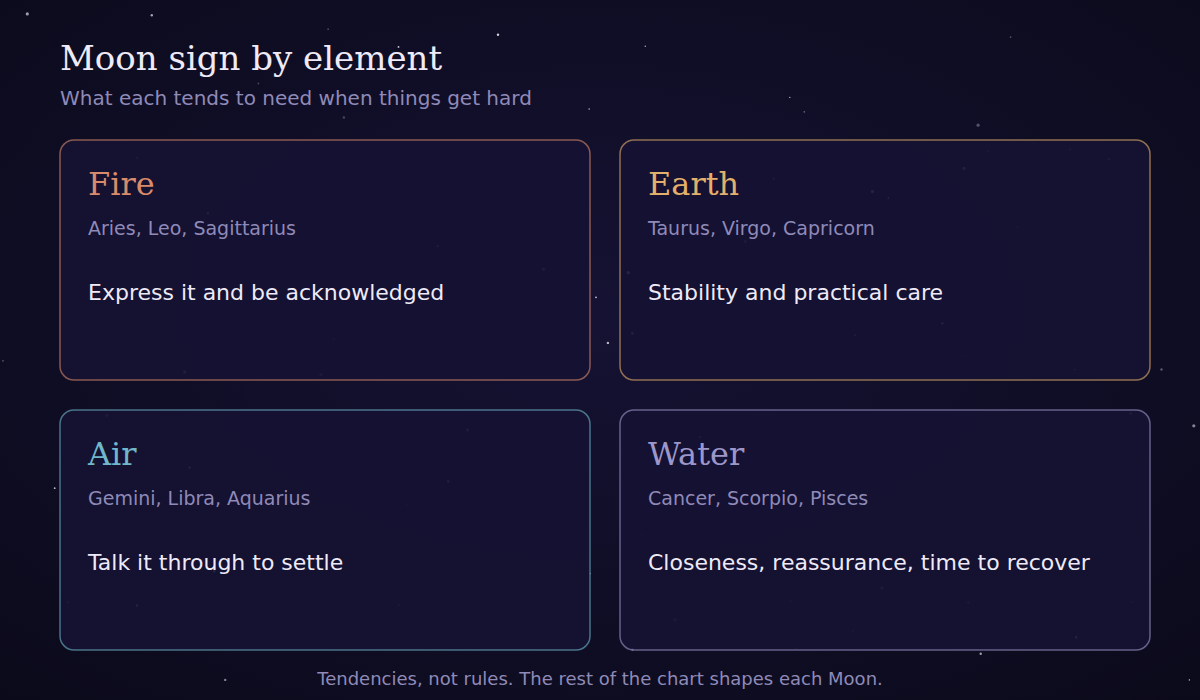
Fire Moons (Aries, Leo, Sagittarius) tend to react quickly and warmly. They often need to express a feeling and have it acknowledged. They tend to move on faster than others.
Earth Moons (Taurus, Virgo, Capricorn) tend to seek stability. Comfort often comes through routine, physical care, and practical support. They may show love by doing things rather than saying them.
Air Moons (Gemini, Libra, Aquarius) tend to process feelings by talking or thinking them through. They may need to understand what they feel before they can settle. Too much intensity can feel overwhelming.
Water Moons (Cancer, Scorpio, Pisces) tend to feel deeply and absorb the emotions around them. They often need reassurance and emotional closeness, and may need time alone to recover.
These are tendencies, not rules. The rest of a chart shapes how any Moon sign shows up.
Text description of this diagram
Title: ‘Moon sign by element.’ Fire (Aries, Leo, Sagittarius): express it and be acknowledged. Earth (Taurus, Virgo, Capricorn): stability and practical care. Air (Gemini, Libra, Aquarius): talk it through to settle. Water (Cancer, Scorpio, Pisces): closeness, reassurance, and time to recover. Note: these are tendencies, not rules; the rest of the chart shapes each Moon.
Comparing your Moon with a partner’s
A helpful exercise is to look at both Moon signs and ask three questions.
1. Do we process feelings at the same speed? A fire Moon and a water Moon can mismatch here. One is done and ready to move on. The other is still feeling it.
2. Do we ask for comfort in the same way? One person may want words. The other may want a meal cooked. Neither is wrong, but each can miss the other’s attempt.
3. What does each of us do when we feel unsafe? Some people pursue. Some withdraw. Knowing which is which can change how an argument goes.
If your Moons are in the same element, you may find each other easy to read. If they are in different elements, you have more to learn about each other, and more to give each other.
Moon-to-Moon aspects in synastry
When astrologers compare two charts, they also look at how the Moons relate. A Moon-to-Moon aspect can suggest ease of emotional understanding or, in tougher cases, friction in how you handle feelings. It is one signal among many, not a rating of the relationship. If you are new to comparing charts, our guide to what a synastry chart tells you is a good place to start.
A caution
A Moon sign is not a personality diagnosis. You are not required to fit your Moon’s description, and a partner who does not match theirs is not being difficult. Use it as a starting point for curiosity: “I noticed I tend to pull away when I’m stressed. Is that what it looks like to you?”
Find your Moon
You can see your Moon placement and compare it with someone else’s in Galaxia. Add your chart and one person you care about and look at where your Moons sit.
A birth chart describes how someone is built. It does not predict what they will do. How Galaxia handles astrology.
See it in your own chart
Add a birth date and Galaxia calculates placements from astronomical positions. No signup required to run a chart.
Run your free chart