Nobody’s Astrology App Has Your Grandmother In It
Galaxia describes what a chart shows, not what will happen. How we write about astrology →
Every astrology app on your phone knows your Mercury placement. Ask it about your grandmother’s, and it has nothing.
Not because the technology can’t do it: computing a chart for someone born in 1948 is no harder than computing one for someone born last year. It’s because no one built the feature. The entire consumer astrology industry quietly narrowed itself down to a single genre: you, your traits, your day, your notifications. The people you actually live your life with (the ones you call when something goes wrong, the ones whose birthdays you’ve had memorized since childhood) show up nowhere. Not in the chart. Not in the horoscope. Not even as an afterthought.
That’s a strange thing for astrology to have become, when you think about it. A birth chart has never meant much in isolation. It’s a set of positions, and positions only matter in relation to something: a moment, a place, another chart. Astrology, as a practice, was never supposed to be a solo act. Somewhere along the way, the apps decided it should be.
Next step
Add your family to one constellation and see how generations overlap.
Map your family free for 14 daysThe apps built around you
Look at what’s actually on the market and a pattern shows up fast: every category, without exception, stops at the individual.
The daily-horoscope apps (Co-Star is the obvious one, The Pattern close behind) are built to open every morning and tell you something about you. Your mood, your energy, your one thing to watch out for today. Beautifully designed, genuinely engaging, and structurally incapable of telling you anything about the actual humans in your day.
The chart-calculator apps, TimePassages being the long-running example, go deeper on the astrology itself: houses, aspects, transits, the real mechanics. But depth on one chart is still depth on one chart. You can learn everything there is to know about your own Venus placement and still have zero way to see how it sits next to your partner’s, your father’s, your best friend’s.
The AI-reading apps are the newest wave: Sanctuary, Astra, and others that let you type a question and get a generated answer back. Some of them are decent. But look closely at how they’re priced: charge-per-question is common, which means the app is incentivized for you to keep asking, not for you to actually understand something and stop needing to ask. And the reading is still about you. Ask an AI-reading app about a relationship and it will, at best, guess.
Three categories, one blind spot. They all stop at you.
What “generational astrology” actually looks like
Galaxia doesn’t stop there, because the interesting part was never just you: it’s what happens when your chart sits next to someone else’s. Add your mother. Add your kid. Add the friend who’s basically family. Every person you add gets a full, real, computed chart, the same as your own, and the app treats every one of those charts as a first-class citizen, not a guest star in your personal horoscope.
The Moon is often the first placement worth reading between a parent and a child. What your mother’s Moon sign says about how she says sorry is that translation.
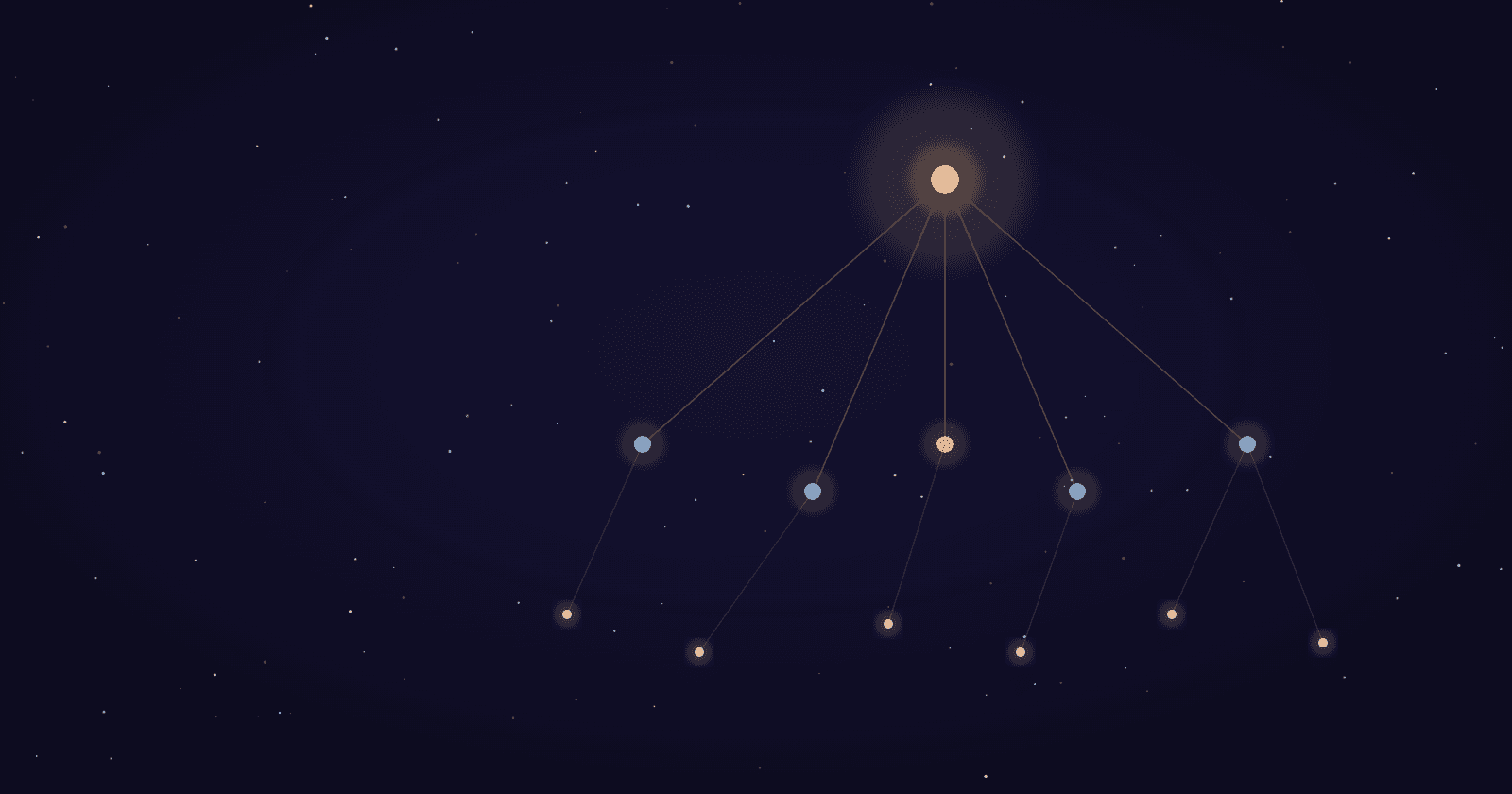
This is what generational astrology means in practice: not a single reading, but a constellation of them, all connected. A transit that’s currently sitting on your Saturn is also sitting somewhere specific in your sibling’s chart, your parent’s chart, your kid’s chart, and it’s landing differently in each one, because each of those charts is different. Seeing that side by side is a completely different experience than seeing your own transit alone. It turns “why am I feeling this way right now” into “oh, this is a family season,” which is often the more honest and more useful question. The same outer-planet layer shows up at work: the colleague you cannot read.
That’s also where a real family astrology chart earns its name. Not a single chart with a label slapped on it, but an actual layered view: your family, computed as a set of related people rather than a single subject. You can hold your chart next to your father’s and see exactly where you run alike and exactly where you don’t, in the same language, side by side, instead of guessing from a lifetime of observation. If you’ve never built one out, Generations is the place to start: that’s the feature this whole idea lives in.
And because it’s a full relational engine and not a compatibility gimmick, it does real synastry: an actual biwheel comparison between any two people’s charts, not a canned “these two signs get along” blurb. If you’re new to what that comparison actually shows, our synastry chart meaning guide walks through how to read one: flows, catches, and what each is actually telling you.
The part no other app will touch
Here’s the section that’s uncomfortable to write about and impossible to skip, because it’s the clearest example of what this app is for.
Every astrology app treats a person as a live subscriber. If you stop opening the app, your chart just sits there unused; there’s no concept of a chart that outlives its owner. Which means the moment someone you love dies, every one of those apps has nothing left to offer you. Not their chart, not a way to keep it, not a way to still ask what a transit means for the relationship you still carry.
Galaxia has memorial profiles. You can add someone who has passed, and their star stays visible in your constellation: not hidden, not archived, not converted into a generic “deceased” flag, but present, the way they still are to you. Their chart doesn’t stop meaning something just because they’re gone. You can still look at where your Moon sat against theirs. If you want a slower walk through that, reading the chart of someone who has died is the companion piece. You can still ask what a transit meant for the two of you, in the past tense or otherwise. It’s a small, specific piece of software behavior, and it is completely uncontested: no competitor has it, because no competitor was ever built to imagine a person outliving their own login.
This is not a feature you market loudly. It’s a feature you build because the alternative (an app that quietly erases someone the day they die) is not one you’d want to be responsible for.
Vela, and the difference between a guide and a meter running
Once you have a constellation of real people, you need a way to actually talk about what you’re seeing, and that’s what Vela is for: Galaxia’s AI guide, included in the monthly subscription at no extra charge, ever. Ask it about a transit hitting two people differently, a synastry pattern between you and a sibling, or what a specific aspect in a family chart tends to mean, and it answers from the same curated, static interpretation library every reading in the app pulls from. It doesn’t improvise, and it doesn’t charge per question the way some of the AI-reading apps above do: there’s no meter running that rewards you for staying confused. Meet Vela if you want to see it in context before you ever open the app.
The point of a relationship astrology app
Step back and the whole thing is a fairly simple bet: a relationship astrology app should be about relationships, not about a single user’s daily forecast with everyone else edited out. The people already in your life (parents, grandparents, partners, kids, coworkers, the friend who became family, the person you lost and haven’t stopped thinking about) are not a feature request. They’re the point.
Nobody’s astrology app has your grandmother in it. Yours can.
A birth chart describes how someone is built. It does not predict what they will do. How Galaxia handles astrology.
Chart everyone who matters
Add parents, siblings, and the people you have lost. Galaxia maps how generations overlap in one place.
Add your family free for 14 daysRead next
Moon Sign in Relationships: Why You Need Different Things
Your Moon sign describes how you process feelings and what helps you feel secure. Here is how to read it next to a partner’s Moon in a birth chart.
Birth Chart Without a Birth Time: What You Can Still Learn
Do not know your birth time? You can still learn a lot from a birth chart. Here is what stays reliable, what does not, and how to find your birth time.