Birth Chart Without a Birth Time: What You Can Still Learn
Galaxia describes what a chart shows, not what will happen. How we write about astrology →
“What time were you born?” is the question that stops a lot of people. If you were not told, or the record was lost, or you are trying to look at a chart for someone else, it can feel like the whole exercise is off the table.
It is not. A chart without a birth time is less detailed, but a good portion of it is still solid.
Next step
Enter a birth date and see placements computed from the sky, free in about 60 seconds.
See your own chart in 60 seconds, freeWhat depends on birth time
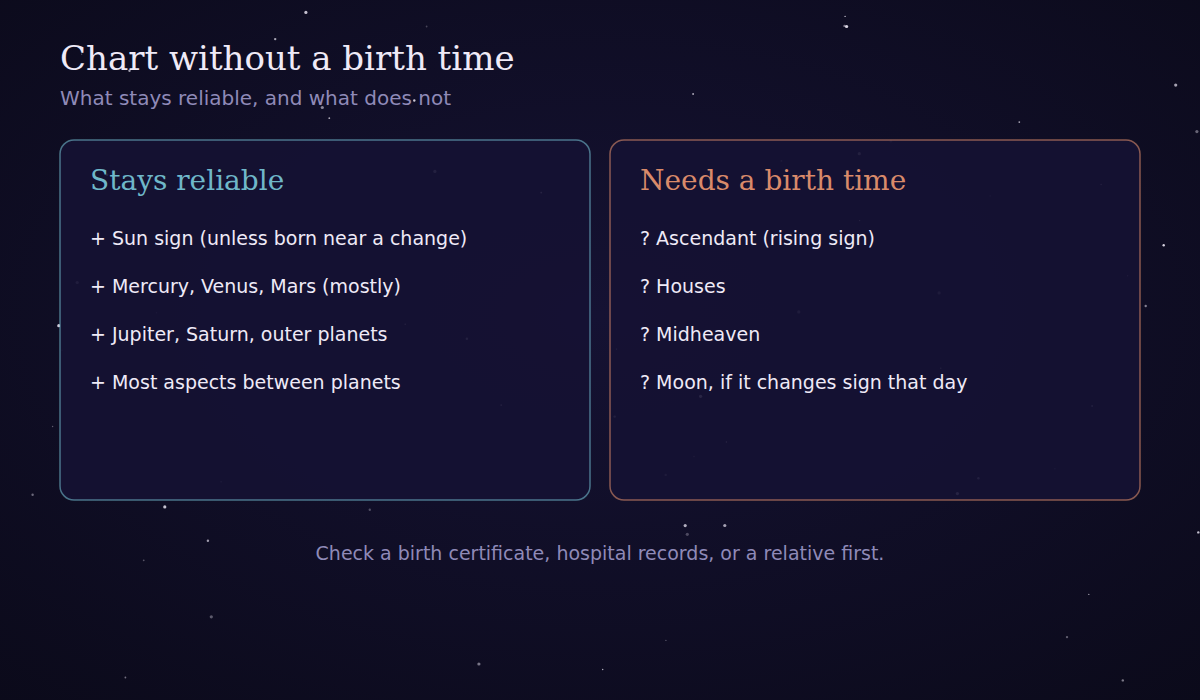
Birth time affects the parts of the chart that change quickly:
- The Ascendant (rising sign). It changes sign roughly every two hours.
- The houses. They are set from the Ascendant, so they shift with it.
- The Midheaven. It also moves through a sign in about two hours.
- The exact position of the Moon. The Moon moves about 12 to 13 degrees a day, so it can sit in a different sign within the same date.
If you do not know the time, treat all of these as unknown.
What stays reliable
The slower parts of the chart are barely affected:
- Sun sign. It only changes if you were born on the very edge of a sign change.
- Mercury, Venus, and Mars. These planets move slowly enough that a few hours makes little difference, though a check is worthwhile near a sign boundary.
- Jupiter, Saturn, and the outer planets. These stay in a sign for months to years.
- Most aspects between planets. They hold, except those involving the Moon.
That is a lot of usable information. It is enough for meaningful comparison with another person’s chart.
Text description of this diagram
Title: ‘Chart without a birth time.’ Stays reliable: Sun sign (unless born near a change), Mercury, Venus and Mars (mostly), Jupiter, Saturn and the outer planets, most aspects between planets. Needs a birth time: Ascendant (rising sign), houses, Midheaven, and the Moon if it changes sign that day. Tip: check a birth certificate, hospital records, or a relative first.
What about the Moon?
The Moon is the tricky one. For most birth dates, the Moon stays in one sign for the whole day, so you can still identify it. But on days when the Moon changes signs, you cannot be sure which one applies.
A common approach is to check whether the Moon changes signs on your birth date. If it does not, you are safe. If it does, note both possibilities and see which one describes you better. Do not treat that as a firm finding.
Ways to find your birth time
- Your birth certificate. In many places, the time is recorded on the long-form certificate, even if the short version omits it.
- Hospital records. You can often request them.
- Ask a parent or relative. Even an approximate time helps: “sometime in the afternoon” narrows the Ascendant to a few options.
- Baby books and old documents. Look for notes made at the time.
If you cannot find it, treat everything time-dependent as provisional.
A note on “rectification”
Some astrologers offer birth time rectification, an attempt to work out the time by matching a chart to major life events. It is an interpretive practice, not a precise method, and results vary. We would not treat a rectified time as fact.
Working with what you have
For a relationship, the placements that do not depend on birth time often give you plenty to work with. Compare the slower planets, look at where the two charts flow and where they catch, and treat house placements as unknown until a time is confirmed.
If you are curious about houses, and how Whole Sign differs from other systems, see Whole Sign houses explained. Otherwise, add your chart and start with what you know.
A birth chart describes how someone is built. It does not predict what they will do. How Galaxia handles astrology.
See it in your own chart
Add a birth date and Galaxia calculates placements from astronomical positions. No signup required to run a chart.
Run your free chart