How People Used Astrology: What They Got Right and Wrong
Galaxia describes what a chart shows, not what will happen. How we write about astrology →
Astrology is one of the oldest continuous human practices, and one of the most argued about. Its defenders tend to say it has always worked. Its critics tend to say it has never worked. The more interesting truth is that people who practiced it were right about some things, wrong about others, and often could not tell which was which.
We build a relationship-focused astrology app, so we think it is worth being upfront about that history. Here is what people traditionally used astrology for, where they were onto something, and where they were not.
Next step
Enter a birth date and see placements computed from the sky, free in about 60 seconds.
See your own chart in 60 seconds, freeA short history of how it was used
Mesopotamia. The earliest astrology we have records of was about the state, not the individual. Babylonian scribes watched the sky and recorded omens: what the Moon, planets, and eclipses meant for the king, the harvest, or a coming war. Personal horoscopes, based on the exact sky at a person’s birth, appear later, around the fifth century BCE.
The Hellenistic world. In Greek-speaking Egypt and beyond, astrologers combined Babylonian observation, Egyptian tradition, and Greek geometry into something closer to the system we know: the zodiac signs, the houses, the aspects between planets. Ptolemy’s Tetrabiblos, written in the second century CE, became a foundational text.
The Islamic world and medieval Europe. Scholars such as Abu Ma’shar preserved, extended, and debated the tradition. Astrology was taught alongside astronomy and medicine. It was also criticized. Al-Biruni, a major astronomer, wrote about astrology in detail while being skeptical about many of its claims.
The Renaissance. Physicians consulted the sky before treating patients. Rulers hired court astrologers. Even Kepler, who helped establish modern astronomy, cast horoscopes for income, while writing that much of astrology was unreliable.
Across these periods, people used astrology for a few main purposes: choosing good times to act (planting, marrying, starting a campaign), understanding character, guiding medicine, and forecasting events.
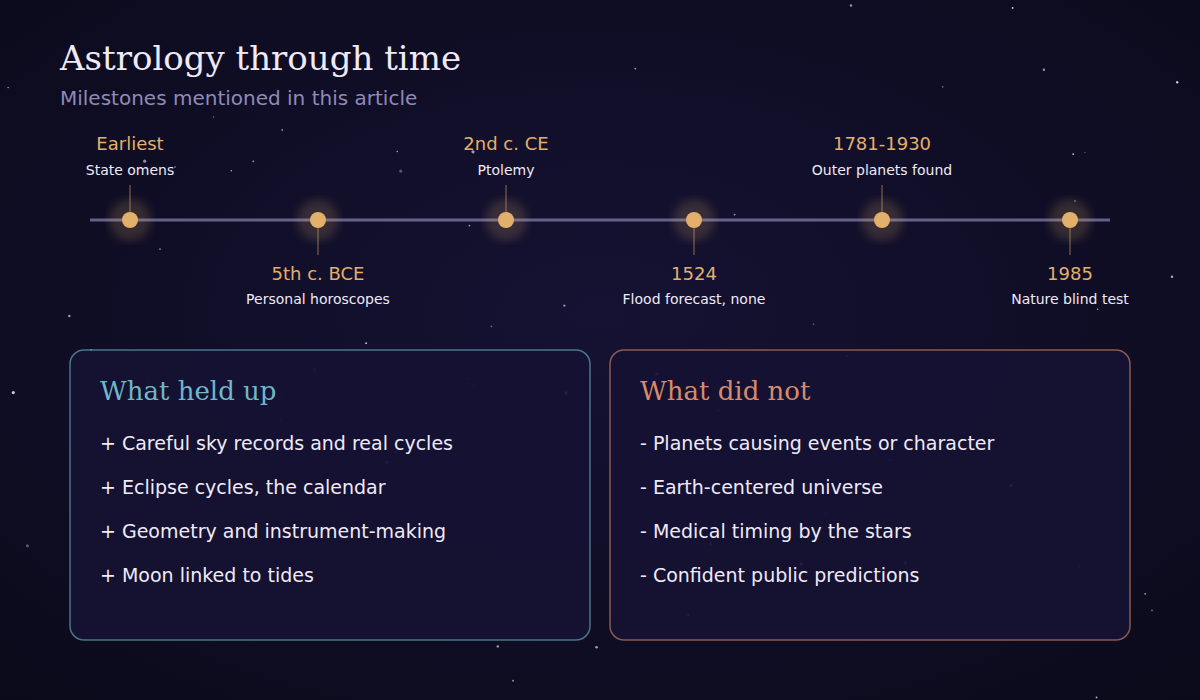
Text description of this diagram
Timeline titled ‘Astrology through time’, with milestones: earliest, state omens; 5th century BCE, personal horoscopes; 2nd century CE, Ptolemy; 1524, a flood forecast that did not come true; 1781 to 1930, outer planets discovered; 1985, a blind test published in Nature. Below, ‘What held up’: careful sky records and real cycles, eclipse cycles and the calendar, geometry and instrument-making, the Moon linked to tides. ‘What did not’: planets causing events or character, an Earth-centered universe, medical timing by the stars, confident public predictions.
What they got right
They watched carefully, and the patterns were real. Ancient astrologers kept meticulous records of the sky over centuries. That work let them discover real regularities: that eclipses recur in predictable cycles (the Saros cycle), that planets move in repeating patterns, and that the Moon, the Sun, and the seasons keep a dependable rhythm. Predicting the sky was astronomy, and astronomy owes a great deal to people whose motivation was astrological.
The calendar. Agriculture, religious festivals, and navigation all depend on tracking cycles of the Sun and Moon. Timekeeping and astrology grew up together.
Mathematics and instruments. Calculating planetary positions pushed the development of geometry, trigonometry, and instrument-making. Some of the tools and tables were built for astrology and later served astronomy.
The Moon and the tides. Astrologers linked the Moon to water and fluids. The tides are in fact driven largely by the Moon’s gravity. The astrological leap from there, that the Moon shapes moods or bodily humors, is a separate claim, and the evidence for it is weak.
Attention itself. Structured reflection has value. Many people who use a chart, whatever they believe about it, report that it gives them a framework for noticing patterns and talking about them. That is a claim about human behavior, not about planets, and it is worth keeping the two apart.
What they got wrong
The causal claim. The central idea, that planets cause events or shape character, has not held up. In one well-known double-blind test published in Nature in 1985, professional astrologers were unable to match birth charts to personality profiles at better than chance. Later reviews have generally reached the same conclusion for Sun-sign personality and prediction.
The picture of the universe. Traditional astrology assumed Earth sat at the center with the planets moving around it in spheres. That is not how the solar system works.
The sign boundaries drifted. Earth’s axis slowly wobbles, so the position of the Sun against the background stars shifts over centuries. The signs used in Western astrology are tied to the seasons, not to the constellations they were named after. The two have drifted apart by roughly one sign since the system was fixed.
Missing planets. For most of history, astrology worked with the planets visible to the naked eye. Uranus was discovered in 1781, Neptune in 1846, and Pluto in 1930. Astrologers added them without the system falling apart, which tells you something about how flexible it is, and how hard it is to test.
Medical astrology. Doctors consulted the sky for when to bleed patients or which herbs to use. This was not merely ineffective; some of it was harmful.
Confident public predictions. Astrologers have repeatedly forecast disasters that did not arrive. A widely cited example: in 1524, a much-discussed alignment of planets in Pisces led some astrologers to forecast a great flood. It did not happen.
The Barnum effect. Broad statements (“you can be generous but sometimes struggle to ask for help”) feel personal to nearly everyone. Much of astrology’s persuasive power comes from this, and it fools believers and skeptics alike.
So where does that leave a modern reader?
Both camps have something right. Skeptics are correct that the evidence does not support astrology as a predictive science. Practitioners are correct that people find something useful in it.
Our view at Galaxia is that the most defensible use of astrology today is as a lens, not a forecast. A chart is a structured way to ask questions about yourself and the people in your life. It does not tell you what will happen. It gives you a shared vocabulary to notice how you and someone else tend to differ, and a reason to have a conversation.
That is why we do not make predictions, and why everything in the app is written to describe, not to promise. How Galaxia handles astrology. If a source tells you exactly what will happen to you next month, it is claiming more than the history of the practice, or the evidence, can support.
If you want to try it as a lens, add yourself and someone you care about and see what questions come up.
See it in your own chart
Add a birth date and Galaxia calculates placements from astronomical positions. No signup required to run a chart.
Run your free chartRead next
Moon Sign in Relationships: Why You Need Different Things
Your Moon sign describes how you process feelings and what helps you feel secure. Here is how to read it next to a partner’s Moon in a birth chart.
Birth Chart Without a Birth Time: What You Can Still Learn
Do not know your birth time? You can still learn a lot from a birth chart. Here is what stays reliable, what does not, and how to find your birth time.