Whole Sign Houses Explained (and Why Charts Differ)
Galaxia describes what a chart shows, not what will happen. How we write about astrology →
If you have ever put your birth details into two different astrology sites and gotten charts that did not quite match, you are not imagining it. One common reason is the house system, the method used to divide the chart into twelve sections. Galaxia defaults to Placidus houses and lets you switch to Whole Sign or Equal in your settings. This post explains how Whole Sign works and why it might explain the difference you noticed.
Next step
Enter a birth date and see placements computed from the sky, free in about 60 seconds.
See your own chart in 60 seconds, freeWhat houses are
A birth chart has three main layers. Planets are what is happening. Signs describe how it is happening. Houses describe where in life it happens: relationships, work, home, money, and so on.
There are twelve houses, each tied to an area of life. The house system determines where one house ends and the next begins.
The Ascendant matters most
The starting point for the houses is the Ascendant, the sign rising on the eastern horizon at the moment of birth. This is why an accurate birth time matters for houses: the Ascendant changes sign roughly every two hours.
How Whole Sign houses work
Whole Sign is the simplest system. The entire sign containing the Ascendant becomes the first house. The next sign becomes the second house, and so on around the chart.
For example, if your Ascendant is at 17° Virgo, all of Virgo is your first house. All of Libra is your second house. All of Scorpio is your third.
Every house has exactly one sign, and every sign has exactly one house. That tidy structure makes the chart easy to read.
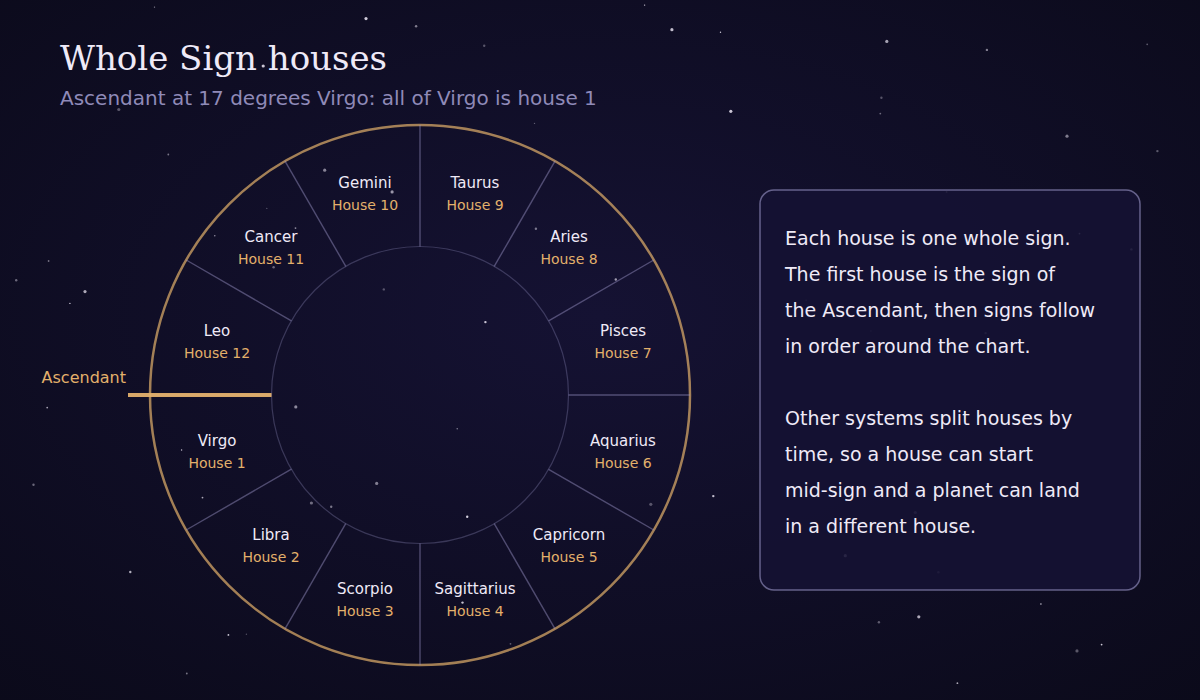
Text description of this diagram
Title: ‘Whole Sign houses. Ascendant at 17 degrees Virgo: all of Virgo is house 1.’ A wheel lists houses counterclockwise from the Ascendant: Virgo 1, Libra 2, Scorpio 3, Sagittarius 4, Capricorn 5, Aquarius 6, Pisces 7, Aries 8, Taurus 9, Gemini 10, Cancer 11, Leo 12. A box explains: each house is one whole sign; the first house is the sign of the Ascendant, then signs follow in order. Other systems split houses by time, so a house can start mid-sign and a planet can land in a different house.
How other systems differ
Systems such as Placidus, popular in modern Western astrology, divide the houses by calculating time-based divisions of the sky. Houses come out in unequal sizes, and a house can start in the middle of a sign. In Placidus, that same 17° Virgo Ascendant would have the first house begin at 17° Virgo, not at the start of the sign.
Because the boundaries move, a planet can land in a different house depending on the system. Two people looking at the same birth data can therefore talk about different houses.
Why the differences matter
Say you have a planet at 5° Libra with a 17° Virgo Ascendant. In Whole Sign, it is in the second house (Libra as a whole). In Placidus, the second house starts partway through Libra, so the same planet could still sit in the first house.
The planet and its sign do not change. The area of life it is assigned to can.
Which system is “right”?
Astrologers disagree, and no system has been shown to be more accurate in any measurable way. Whole Sign is the oldest known system, used in Hellenistic astrology, and it has seen a revival among modern practitioners. Placidus remains widely used. Neither is objectively correct.
Why some people prefer Whole Sign
Many astrologers prefer Whole Sign for a few practical reasons:
- It is consistent. Every house is one sign, so a small error in birth time is less likely to push a planet into a different house, except when the Ascendant itself changes signs.
- It is transparent. The rule fits in one sentence, so you can check the result yourself.
- It holds up at high latitudes, where some time-based systems break down or distort.
Those are reasons the system is appealing, not proof that it is more accurate. If you prefer another system, the planets and signs in your chart will still match.
What to do if your chart looks different
If a chart from another source does not match ours, check the house system first. The planets and signs should be identical. If those differ, check the birth time and location.
If you do not know your exact birth time, houses will be less reliable. You can still learn a lot from signs and aspects. We cover that in our guide to what you can learn from a chart without a birth time.
You can switch it in Settings, in the House system section.
A birth chart describes how someone is built. It does not predict what they will do. How Galaxia handles astrology.
See it in your own chart
Add a birth date and Galaxia calculates placements from astronomical positions. No signup required to run a chart.
Run your free chart