Uranus Retrograde in Gemini 2026 and Your Relationships
Galaxia describes what a chart shows, not what will happen. How we write about astrology →
Uranus stationed retrograde in Gemini on September 10, 2026, and it will stay retrograde until early February 2027. Every horoscope site has a version of the same article: what this means for you, sorted by Sun sign.
Here is the problem with that. A transit does not land on a Sun sign. It lands on a specific point in a specific chart. Two Geminis can live through this retrograde completely differently, and a Pisces can feel it more than either of them. So the useful question is not “what will happen to me?” It is: does this apply to me at all, and if so, to which of us?
That is the only version of the question that is both honest and answerable. This post walks through how to answer it for a relationship you are already in.
Next step
Enter a birth date and see placements computed from the sky, free in about 60 seconds.
See your own chart in 60 seconds, freeWhat Uranus retrograde actually is
Uranus is the slowest-moving planet most astrologers use in everyday work, taking about 84 years to circle the zodiac. It spends roughly seven years in each sign. Traditionally it is associated with disruption, sudden change, independence, and the urge to break a pattern that has stopped working.
Every year, Uranus appears to move backward for a stretch of months. That is a retrograde, an optical effect of Earth’s orbit rather than anything the planet is doing. Astrologers read the retrograde as the same energy turned inward: less about external shocks, more about reconsidering what you already set in motion.
In Gemini, the themes are the Gemini ones: communication, information, how you talk to each other, how you learn, siblings and neighbors, the daily rhythms of a shared life.
Why “for your sign” is the wrong unit
Sun-sign forecasts treat 12 groups of people as if they share a sky. They do not. Your Sun sign tells you where the Sun was on the day you were born. Uranus does not care about it.
What matters is where Gemini falls in your chart, and whether Uranus is making contact with a planet or angle you have placed there. Someone with Mercury, Venus, or the Moon in early Gemini has a direct line to this transit. Someone with nothing in Gemini and no hard aspects to it may barely notice.
This is why a sweeping statement like “communication will break down in relationships” is not a fact about anyone. It is a horoscope-shaped guess.
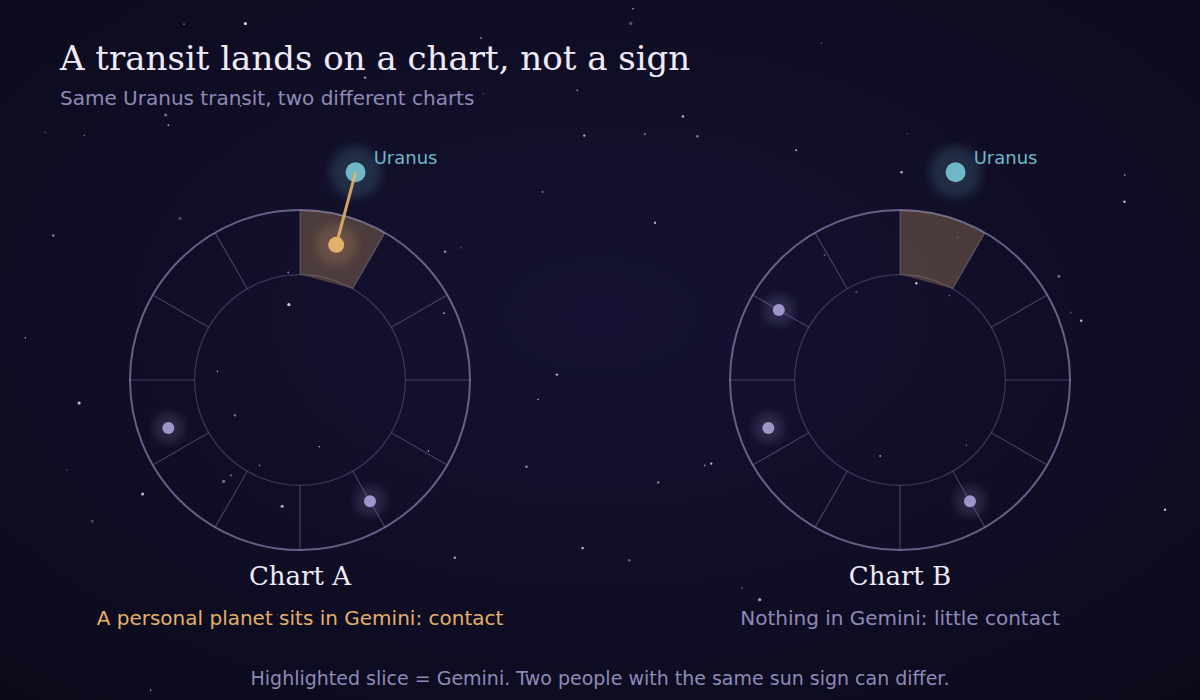
Text description of this diagram
Two circular chart wheels are shown side by side under the title ‘A transit lands on a chart, not a sign.’ In Chart A, a personal planet sits inside the highlighted Gemini slice and a gold line connects it to a Uranus marker: contact. In Chart B, no planet sits in Gemini, so no line connects to Uranus: little contact. A footnote reads: ‘Highlighted slice = Gemini. Two people with the same Sun sign can differ.’
The relationship question: whose chart, and where?
If you are in a relationship, there are three charts in play: yours, theirs, and the one the two of you form together. A transit can touch any of them differently.
Here is a practical way to check:
1. Find the sign and house. Look at where Gemini falls in each of your charts. Uranus is moving through that area of life for both of you, in different places.
2. Look for contact with personal planets. A planet in Gemini, or one that makes a close aspect to it, is where Uranus shows up. Sun, Moon, Mercury, Venus, and Mars are the ones that tend to make it personal.
3. Compare, do not merge. If it touches you and not them, that is a very different conversation than if it touches both. One person may feel restless while the other feels steady, and neither is wrong.
4. Check the synastry. If Uranus is crossing a point where one of your planets sits close to one of theirs, the transit can land on the connection itself. That is the situation worth paying attention to. (If synastry is new to you, start with what a synastry chart actually tells you about a relationship you’re already in.)
What “applies to you” might look like
We do not predict events, and neither should any astrologer worth listening to. What a transit can do is describe a pressure, a theme that is more likely to come up. In a relationship, Uranus in Gemini might show up as:
- A pattern in how you communicate that suddenly feels stale, and a wish to change it
- One of you wanting more independence in how you spend your days while the other wants more routine
- Old assumptions about “how we talk about things” being reopened
- A sense that information you always accepted needs a second look
None of these are guaranteed. They are themes to look for in your own life, and to check against what is actually happening rather than assuming.
What the retrograde changes
Retrograde periods are traditionally read as a time to review rather than launch. With Uranus, that can mean noticing where you have been running on autopilot in a relationship, and deciding what to keep. It is a good excuse to have a conversation you have been putting off, not a reason to blow something up.
Because Uranus moves slowly, the effect is gradual. This is a months-long backdrop, not a single bad week.
How to look at your own charts
The honest way to use this transit is to look at your specific placements, not a sign-level summary. In Galaxia you can add yourself and the people in your life, see where the current transits touch each chart, and compare them side by side, so you can tell whose chart Uranus is actually working on.
If a forecast tells you what will happen to you based on your Sun sign alone, treat it as entertainment. If it can tell you which planet, which house, and whose chart, it is telling you something you can check.
A birth chart describes how someone is built. It does not predict what they will do. How Galaxia handles astrology.
See it in your own chart
Add both charts to see whether Gemini touches either of you, and which of you feels it.
Run your free chart